
Shear Affected Zone
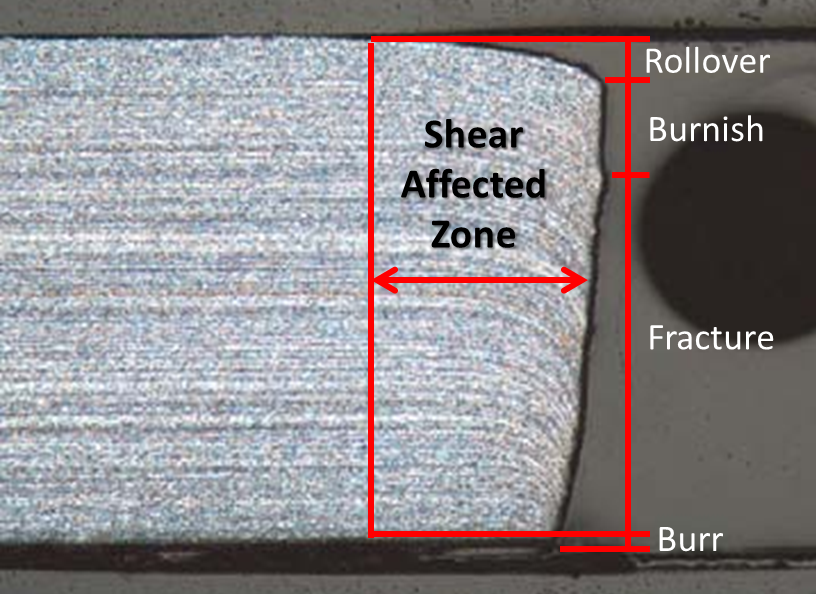
Many studies conclude plastic deformation within the SAZ is a key contributor to sheared edge stretching failures. The Shear Affected Zone is the area of work-hardened steel and microstructural damage behind the sheared edge. The deformation pattern in the SAZ includes a large shear-induced rotation of the grains that increases with proximity to the sheared edge.
An etched cross-section such as that shown in Figure 1 highlights the grain rotation and gives a visual indication of the size of the zone.
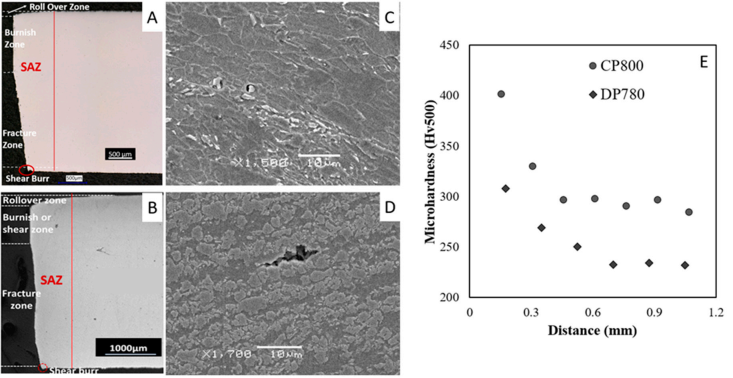
Work hardening in the SAZ leads to a way to quantify the depth of the SAZ: by creating a hardness profile with readings starting at the edge and progressing deeper into the metal. The end of the SAZ occurs when the hardness readings level off to the bulk hardness.
Figure 2 compares the edge and hardness readings for CP800 and DP780, showing the depth of the SAZ for DP780 is about 41% of the initial sheet thickness of 1.56 mm, and the depth of the CP800 SAZ is 20% of the initial 2.90 mm sheet thickness.P-12
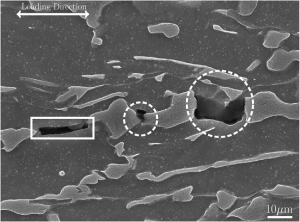
Plastic deformation from cutting and subsequent edge expansion forms micro-voids and creates other microstructural damage. The voids grow and combine with neighboring voids to create micro-cracks, which in turn combine with other micro-cracks resulting in the cracks that cause fractures in stampings.
Void nucleation in DP steels occurs through two mechanisms: decohesion of the ferrite-martensite interface or fracture of martensite islands.P-12, A-27, A-28 Figure 3 shows an example of both.
The study in Citation P-12 compared CP800 and DP780. The CP800 microstructure contains ferrite, bainite, and martensite.
The DP780 microstructure has more martensite, with a larger strength differential between the phases, which combines to result in a lower nucleation strain and accelerated void nucleation compared with CP800.
The DP grade has a larger SAZ, further promoting nucleation, growth, and coalescence of voids. This results in failure at a lower strain and leads to the lower edge stretchability of the DP780 compared to the CP800 alloy.P-12
The ductility of bainite restrains void initiation at high strains, which may play a role in improved sheared edge performance.S-24, S-25
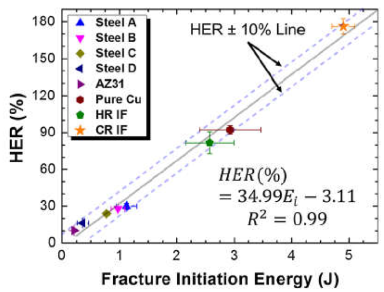
Fracture initiation energy, a measure of fracture toughness correlates with hole expansion and stretch-flangeability as shown in Figure 4.Y-5
In addition to microstructural damage and fracture mechanics, simulation models improve in accuracy when the incorporating the effect of the temperature increase in the localized deformation zone.
Simulation of the blanking of AISI 1050 shows a temperature at the cut edge of 440 °C. The edge temperature may be even higher in AHSS grades due to their higher strength.A-29
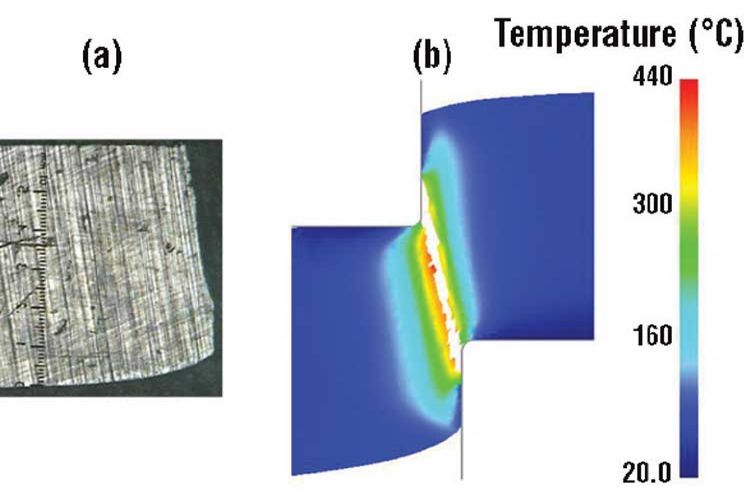
When factoring in the considerations described here, simulation accuracy of hole expansion and sheared edge stretching improves significantly. Citations L-13 and L-14 provide additional background information about the Shear Affected Zone.
References
- K-1Citation: K-1. A. Konieczny, “Advanced High Strength Steels – Formability", Presented at 2003 Great Designs in Steel, Sponsored by American Iron and Steel Institute.
- P-12Citation: P-12. N. Pathak, C. Butcher, M.J. Worswick, E. Bellhouse, and J. Gao, “Damage Evolution in Complex-Phase and Dual-Phase Steels during Edge Stretching", Materials (Basel, Switzerland), 2017, 10(4), 346.
- A-27Citation: A-27. G. Avramovic-Cingara, C.A.R. Saleh, M.K Jain, and D. Wilkinson, “Void Nucleation and Growth in Dual-Phase Steel 600 during Uniaxial Tensile Testing,” Metallurgical and Materials Transactions A, 2009, Vol 40. 3117, doi.org/10.1007/s11661-009-0030-z.
- A-28Citation: A-28. E.E. Aşık, E.S. Perdahcıoğlu, and A.H. van den Boogaard, “Microscopic investigation of damage mechanisms and anisotropic evolution of damage in DP600,” Materials Science and Engineering: A, Vol. 739, 2 January 2019, p. 348, doi.org/10.1016/j.msea.2018.10.018.
- S-24Citation: S-24. M. Sudo, S. I. Hashimoto, and S. Kambe, “Niobium Bearing Ferrite-Bainite High Strength Hot-rolled Sheet Steel with Improved Formability”, Trans. ISIJ, 1983, vol. 23, p. 303.
- S-25Citation: S-25. M. Sudo and T. Awai, “Deformation Behavior and Mechanical Properties of Ferrite-Bainite-Martensite (Triphase) Steel,” Trans. ISIJ, 1983, vol. 23, p. 294.
- Y-5Citation: Y-5. J.I. Yoon, J. Jung, J.G. Kim, S.S. Sohn, S. Lee and H.S. Kim, “Key factors of stretch-flangeability of sheet materials,” Journal of Materials Science, 2017, 52 (13), doi.org/10.1007/s10853-017-1012-y
- A-29Citation: A-29. S. Scheib, P. Satkulvanich, and T. Altan, “Examining edge cracking in hole flanging of AHSS Part II: Modeling of blanking,” Stamping Journal, September 2008.
- L-13Citation: L-13. B.S. Levy and C.J. Van Tyne, “Failure During Sheared Edge Stretching," Journal of Materials Engineering and Performance, Vol 17, p.842 (2008).
- L-14Citation: L-14. B.S. Levy and C.J. Van Tyne, “Review of the Shearing Process for Sheet Steels and Its Effect on Sheared-Edge Stretching,” Journal of Materials Engineering and Performance, Vol 21, p. 1205, 2012.