

Articles

Steel E-Motive Steel Structures for Autonomous MaaS Vehicles: Progress Update
The WorldAutoSteel Steel E-Motive program has been moving along now for nearly a year, and we’d like to share an update with you, our engineering colleagues, on some of the design decisions we’re facing. If you recall, the Steel E-Motive program is designing vehicle concepts for Mobility as a Service (MaaS), characterized by autonomous, electric, […]
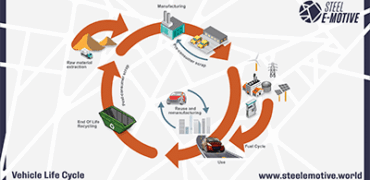
Life Cycle Assessment: 6 areas designers need to consider when taking an LCA approach to vehicle development
Designing vehicles with an LCA focus is a new concept for most product designers. In this blog,Russ Balzer, Technical Director for WorldAutoSteel and Dr. Don Malen, College of Engineering at the University of Michigan, we define six areas for designers to consider when taking an LCA approach to vehicle development: Functional Equivalence, Material utilization, Material […]

Introduction to LCA: A steeluniversity.org course
This two-hour course, Introduction to Life Cycle Assessment, introduces the methodology to analyze the environmental burdens of product and service systems. Prof Dr. Matthias Finkbeiner guides you in exploring life cycle assessment (LCA) through the use of instructional videos. Society requires the means to process a tremendous amount of data to make informed decisions for […]
Importance of LCA in the Automotive Sector
In this video, Russ Balzer LCACP, Technical Director, WorldAutoSteel, explains the importance Life Cycle Assessment (LCA) plays in fully determining vehicle environmental impacts. After viewing the video, check out some of the other resources available to learn more about LCA, its importance and why it is should be included in the next generation of vehicle […]
PHS in Automotive Applications: An Abridged History
Today’s AHSS Insights blog provides a snapshot of how Press Hardened Steels began and spread to vehicle applications around the world. Written by Dr. Eren Billur, Billur Makine and Billur Metal Form, Ankara, Turkey and author of Hot Stamping of Ultra High Strength Steels, it is a summary version of a much more detailed article that […]

Developing the Steel E-Motive Vehicle Architecture Specifications
Neil McGregor, Ricardo’s Chief Engineer for Steel E-Motive, in today’s blog talks about the process used to develop this unique vehicle’s requirements and some of the decisions that have been made on the structural specifications. Read the blog to learn more about the Steel E-Motive program progress. In our two and half year journey, we […]

Steel Materials and Technologies for Steel E-Motive’s Portfolio
Steel E-Motive’s vehicle architectures will use some of the newest steel materials and technologies, those currently available and those that will become commercially available in the 2030+ timeframe. George Coates, WorldAutoSteel’s Technical Director for Steel E-Motive, provides some insights into the steels and steel technologies that will be included in the program’s vehicle architecture […]
Steel E-Motive Blog Considers MaaS Architecture Design Challenges
In our first blog for the Steel E-Motive program, Owain Davies, Ricardo’s Vehicle Architecture Leader, Steel E-Motive Project, considers the vehicle architecture challenges for designing Mobility as a Service (Maas), characterized by connected, electric and autonomous vehicles. Click to read Owain’s perspective on developing Steel E-Motive designs >>> WorldAutoSteel and Ricardo will communicate on progress […]
Upgrading Tool Steels for AHSS
Multi-phase steels are complex to cut and form, requiring specific tooling materials. The tooling alloys which have been used for decades, such as D2, A2 or S7, are reaching their load limits and often result in unacceptable tool life. The mechanical properties of the sheet steels achieve tensile strengths of up to 1800 MPa with […]